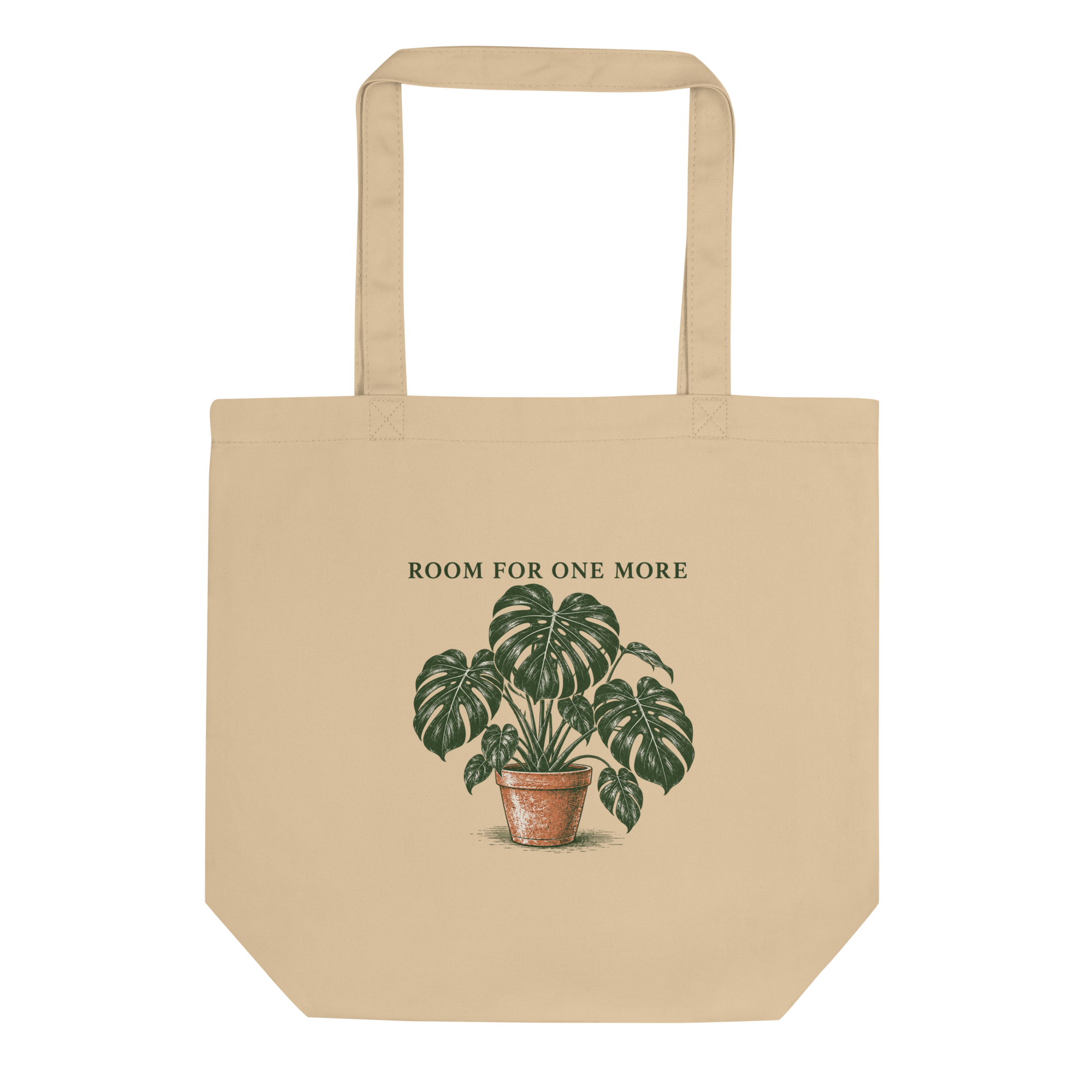
Your nursery trip was supposed to be a quick look. Now you have a fern, a receipt and a very flexible definition of 'enough plants.' A tote can carry the notebook and everyday bits of that outing; choose a proper carrier for anything that needs to stay upright. Start with the trip you actually make, then find a design that gets the joke.
For a useful everyday choice, check four things: the bag's dimensions, opening, straps and care instructions. Then choose the artwork. The leaves on the front can express your personality; they don't turn an everyday tote into a carrier for wet pots or sharp tools.
Here is a fictional bookshop-and-nursery trip: notebook, cardigan and paperback, with a new plant travelling upright in a separate suitable carrier.
Pack the pretend Tuesday before buying the tote
Try the errands with objects you already own. Put the notebook, cardigan and paperback on the table, then add the things that always seem to appear: keys, glasses and the receipt you intend to keep until it becomes confetti. This is the load the tote needs to suit. The imaginary perfect version of your day can use an imaginary bag.
For a worked version of the fictional trip, imagine the notebook is ten inches tall and eight inches wide. Write those measurements beside the bag's stated dimensions and opening. If the listing says only 'one size' and does not give the needed measurements, the comparison is still open. A photograph cannot settle whether that notebook will slide through comfortably.
Now decide which items need protection. A loose notebook may be fine beside a cardigan, while glasses need their case and a drink needs a secure container. An open tote does not create those protections for you. Use the containers you already trust and compare the combined space with a familiar bag.
The decision record is now specific: notebook, ten by eight inches; bag opening, not stated; next step, ask the store for measurements before ordering. Once that answer is clear, choose the design for the day you actually have. Your paperback has not volunteered to become compost.
Turn the missing measurement into one useful question
For that notebook trip, send a question the store can actually answer: “I'm considering the Room for One More tote in Oyster. My notebook is 10 inches tall and 8 inches wide. Could you confirm the bag's usable opening width, body height and base depth? I'd also like the strap drop, measured from the top of the bag to the top of the straps, so I can compare it with my everyday bag.”
Keep the notebook measurements in the question and check the reply against the exact item. The approximate print width on the product page describes the artwork, not the bag opening. Those are two different measurements, even when both happen to involve inches.
If the reply gives only an overall bag width, ask whether that is also the usable opening. A fit decision is still unfinished until the measurement answers your question. Once it does, compare the cardigan and paperback together in a familiar bag. That is a useful rehearsal for your own load, not a test of the tote you haven't received.
1. Picture the ordinary trip
Think about the outing you make most often. A bookshop visit calls for a different load than picking up a small plant and a few nursery purchases. List the items you normally take with you and anything you expect to bring home.
Keep the first decision simple: what would make this bag useful on an ordinary day? A design you love deserves a format you will actually use. If the trip needs a secure closure, protected compartments or a carrier designed to keep a plant upright, look for those features specifically instead of assuming a basic tote provides them.
2. Compare dimensions with the objects you carry
Read the measurements on the exact listing and check the selected size. Width, height and depth answer different questions. A flat bag may look large in a picture while providing a different usable shape from a bag with a defined base.
Measure a bag you already like, then compare it with the listing. You can also measure the largest ordinary object you plan to carry. Leave room for comfortable placement and removal rather than expecting an exact edge-to-edge fit. A product image alone cannot establish usable capacity.
“One size” describes the available option. It does not mean the bag fits every purpose. If a dimension is missing and it would affect your choice, ask the store through its contact page before ordering. Do not fill the gap with an estimate based on the model image.
3. Check the opening and straps
Decide whether an open main compartment suits the outing. It can make access straightforward, but it is a different choice from a zipped or otherwise secured bag. Check the written specification for the actual closure rather than treating a folded product photograph as proof.
Consider how you prefer to carry a bag. Strap dimensions and the shape of the load matter, particularly if you usually wear a coat or want to carry it on your shoulder. Compare the specifications with a bag you use comfortably. A supplier description is useful information, but it is not a physical fit test on you.
Avoid promising that the bag will carry an entire shopping list before checking its stated limits. If the listing gives a supplier weight limit, treat it as a product specification, not a reason to pack every trip to that maximum. Choose a purpose-built carrier for a task that needs protection or a specialized structure.
4. Read materials and care together
The fabric description helps you understand the product, while the care instructions explain how to look after the printed item. Read both. Do not apply the washing routine for another canvas bag simply because the material sounds familiar.
The current Room for One More tote listing identifies an Econscious EC8000 organic cotton canvas tote in Oyster with an open main compartment. It advises spot cleaning when possible and notes that measurements can vary slightly. Those are details from the written listing; this guide does not report a physical sample test.
Ask whether that care routine fits your intended use. A bag for clean everyday belongings has a different exposure from an item you expect to set on wet soil. If frequent machine washing is essential, confirm that the exact printed product supports it before buying. Do not infer that permission from the fabric name alone.
5. Choose a design that feels like your routine
Now compare the artwork. A leafy design can connect with a houseplant habit, while a soil or compost joke might suit someone who enjoys garden humor. You do not need to fit every interest into one item. Pick the idea you would enjoy carrying outside the house.
For a gift, choose the joke you can connect to a person. Room for One More makes sense for the friend who keeps finding another patch of windowsill. A quieter botanical design may suit someone who loves the plants but prefers their accessories to speak softly. Either way, pick something you can imagine them carrying on an ordinary Tuesday.
Browse the plant people collection and garden humor collection as starting points. Check the product type as well as the design name. A collection can include shirts and other items, so confirm you are looking at the tote version before comparing practical details.
6. Read the preview as a preview
Read the product page’s image caption with the selected variant and written specifications. A digital supplier preview shows the intended artwork and placement; it is not a photograph of a delivered item. If an exact shade or placement matters to your choice, ask the store before ordering.
7. Plan the arrival separately from the design choice
A product that fits your taste may still be unsuitable for a close event date. Sprout Mischief products are made to order. Read the current shipping policy and the delivery information available for your destination before paying.
Allow time for production as well as transit, especially for a gift. Check whether the arrival date is an estimate or a guarantee before relying on it.
Read the returns policy separately. Check how it treats a change of mind and how it handles a damaged, misprinted or incorrect item. If you are choosing a surprise gift, those terms are part of the decision. Keep the order details and any answer that influenced your purchase.
Use a short tote comparison worksheet
Complete the same checks for each item on your shortlist. Write “not stated” when the listing leaves a question open.
| Decision | What to record | Why it matters |
|---|---|---|
| Ordinary use | The actual trip and belongings | Keeps the choice tied to a real routine |
| Size | Listed width, height and depth | Helps compare the bag with objects you carry |
| Opening | Open compartment or a stated closure | Shows whether the structure suits the outing |
| Straps | Listed dimensions and preferred carrying style | Gives you a practical fit question to check |
| Care | Instructions for the exact printed item | Prevents assumptions based on another bag |
| Artwork | Design, color and selected variant | Connects the preview with the item being ordered |
| Timing | Production and delivery information | Keeps an event deadline separate from taste |
| Terms | Current return conditions and contact answer | Helps you understand the purchase before paying |
Your next step
Choose one ordinary trip and compare a tote you already use with the exact listing you are considering. Check the opening, dimensions and care routine first, then choose the artwork. Resolve the one missing detail that could change your decision before ordering.
Start with the Room for One More tote, or use the gardening gift guide when you are buying for someone else. For a question the listing does not answer, use the contact page. A thoughtful choice combines a design you enjoy with a bag whose stated use fits the job.